The Mental Framework Professional SEO Teams Actually Use
Most SEO audits die as a PDF
Someone runs an audit, produces a 40-page document full of findings, emails it to the dev team, and nothing happens. Three months later, the same audit surfaces the same issues. I have watched this loop repeat at company after company.
The problem is not laziness. Most people learn SEO as a list of tactics: meta descriptions, alt text, sitemaps, headings. They can execute the checklist, but they cannot diagnose, so a report becomes 50 findings instead of a plan.
Professional SEO teams operate on a different mental model. After years of running technical SEO end-to-end on production sites, shipping fixes into codebases myself instead of handing over recommendations, I can tell you the model is not complicated. But it does require asking a different first question than most people are taught.
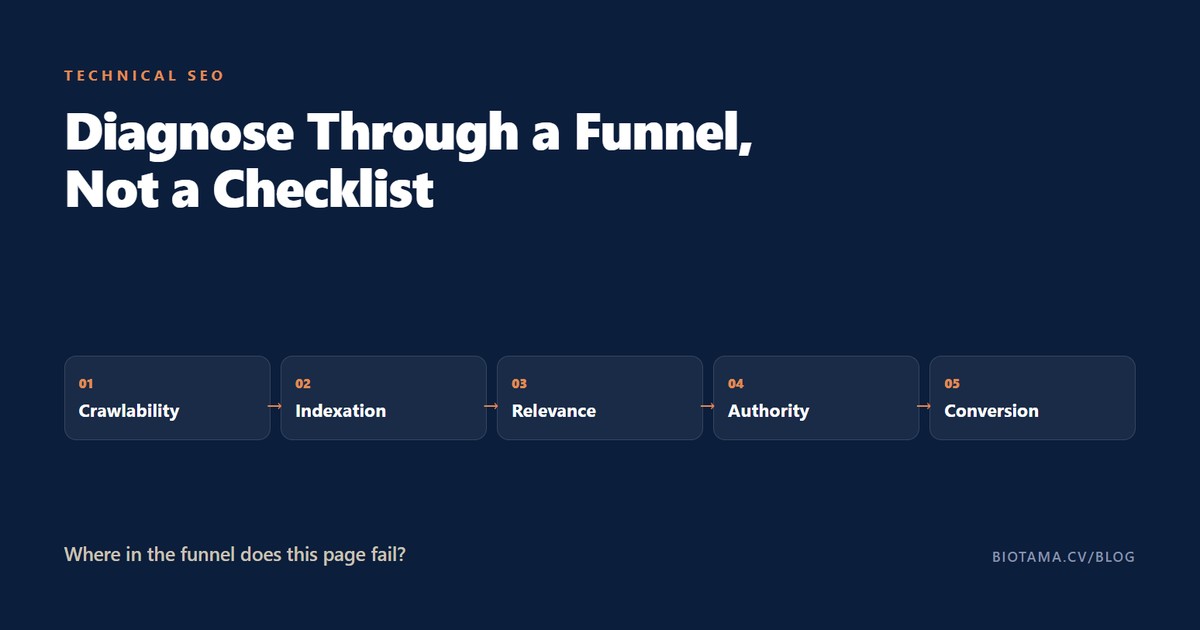
1. Diagnose through a funnel, not a tactic
When a page does not rank, a junior opens the title tag. A professional asks: where in the funnel does this page fail? Every SEO problem lives in one of five stages.
| Stage | Key question | Symptoms of failure |
|---|---|---|
| Crawlability | Can Googlebot reach and render the page? | Unexpected status codes, JS-only content, forgotten robots directives |
| Indexation | Is the page in the index? | "Crawled, currently not indexed", duplicates, canonicals pointing elsewhere |
| Relevance | Does Google consider it relevant for the query? | Indexed but invisible beyond position 50 |
| Authority | Does the site earn enough trust to compete? | Stuck at positions 4-10, losing to stronger competitors |
| Conversion | Does the traffic it gets convert? | Impressions without clicks or sales, high bounce |
The stages are sequential. Fixing relevance when the problem sits at crawlability is effort with zero return, because the page does not enter the competition at all.
I hit a concrete example of misdiagnosis this month. New products on an ecommerce site were not appearing in search. The team assumed a content problem and started rewriting product descriptions. The real cause sat two stages up the funnel: the sitemap was a static file listing 14 old products while the live catalog had 18. Four products had no inbound links, no sitemap entry, and no path to discovery. Google had no way to see them. No content optimization would have fixed that. I regenerated the sitemap from the product API so it could not drift from the catalog again, deployed it, and the products entered the index within days.
2. Treat each change as a testable hypothesis
Professional SEO work sounds like this: "If I implement X, I expect indicator Y to move within Z weeks." Adding Product structured data should raise click-through rate from search results within 30 days. If it does not, the hypothesis dies.
The part that gets skipped: a baseline before you touch anything. Most teams ship a change, see movement a month later, and have no way to know whether the change caused it or a seasonal pattern did. A hypothesis without a recorded baseline is not a test, it is a vibe.
So before each change, write down three things: the expected effect, the indicator that will show it, and the window in which you expect movement. Then check the window. Structured data might lift CTR within 30 days. A content overhaul might need 90 days. A site migration might take six months to fully settle.
| Change | Realistic window |
|---|---|
| Structured data addition | ~30 days to see CTR movement |
| Content overhaul | ~90 days |
| Site migration | ~6 months to fully settle |
There is a quieter benefit. A hypothesis journal, even a spreadsheet with one row per change, builds institutional memory. Six months later you answer "did the FAQ schema help?" with data instead of a recollection. Sometimes a "best practice" turns out to do nothing for your specific site, and you get to stop paying for it.
3. Prioritize by impact times effort times risk
A good audit does not produce 50 findings. It produces five ordered fixes. Three questions decide the order.
| Question | What to count |
|---|---|
| Impact? | How much traffic or value does this issue block? A small issue on a high-traffic page beats a big issue on a page with thin traffic. |
| Effort? | How long does the fix take, and does it need another team? |
| Risk? | What are the side effects? A migration and a blog post carry different risk profiles. |
A worked example. Suppose an audit finds: 300 redirect chains, missing structured data on product pages, thin category descriptions, and slow Largest Contentful Paint on mobile. The naive team fixes redirect chains first because 300 sounds big. The professional team starts with structured data on the highest-traffic product pages: high impact, low effort, low risk. Then mobile LCP: high impact, medium effort, low risk. Thin descriptions wait, because content production is slow and the ROI is unproven. The redirect chains get batched into a maintenance ticket, because most of them sit on pages with thin traffic. The order comes from the math, not from the size of the number in the audit report.
4. Data wins, opinions lose
"I think this title is better" has no place in a professional team. Decisions stand on search volume, on what the SERP displays for the query, on competitor gaps, and on click data from Search Console.
The most underused data source is the SERP itself. Search your target keyword and read what Google chose to reward. If the query returns product pages, Google reads the intent as transactional, and your 2,000-word guide will not rank, however well you write it. If it returns "what is" articles, a product page will not rank. Teams lose months optimizing pages against an intent the SERP does not have.
The second discipline is separating correlation from causation in your own metrics. A page ranking #1 with a high bounce rate is not a success story. It might be winning the wrong intent: searchers arrive, realize the page does not answer their question, and leave. The ranking is real, the traffic is real, and both point at the wrong target. Segmented analytics reveal this. Aggregate dashboards hide it.
The honest version of data-driven also means recording when the data is thin. A new site with 40 monthly clicks cannot support meaningful CTR conclusions, and pretending otherwise leads to confident decisions built on noise. Say so, wait for volume, decide then.
5. Ranking is a proxy, not the goal
Position #1 means little when visitors do not click and nothing converts. The metrics that matter: clicks, engagement, and organic revenue.
This distinction changes how you report. A ranking report tells the SEO team how the game is going. A revenue report tells the business whether the game is worth playing. When I report to stakeholders, I talk about the organic channel's contribution to revenue and pipeline, not how many keywords moved up three positions.
There is a reason this matters beyond optics. Ranking reports create the wrong incentives. Chase positions and you end up targeting keywords that are easy to win but convert poorly. Tie SEO to revenue and you drift toward keywords with commercial intent, pages that support the buying process, and fixes that remove friction from high-value journeys. The metric you report is the strategy you are running.
6. Context before content
Before writing or optimizing anything, answer three questions. Who is searching, and what is their intent, informational or transactional? Where are they in the buying journey? What format does Google reward for this keyword: a product page, an article, a video, a listicle?
Reading the top 10 results for your target keyword before writing a single word is a habit that sounds obvious and gets skipped constantly. Those 10 results are the specification. They tell you the format, the depth, the angle, and the entities Google associates with the topic. Content gets built for a specific SERP, not for "SEO" in general.
The teams that skip this step produce technically flawless content that ranks nowhere, because it answers a question the SERP is not asking.
7. Honest time horizons
Technical fixes can show results in weeks. Content and authority take three to six months. Professionals say this out loud at the start of an engagement, so stakeholder expectations do not explode in month two.
The corollary is knowing which metrics move first. Crawl frequency and index coverage respond to technical fixes within days. Rankings follow in weeks. Revenue follows rankings with another lag. Promise process and leading indicators instead of a ranking number. "By week four we expect index coverage on the new collection pages, and we will know if the migration landed clean" is a commitment you can keep. "We will double your traffic in three months" is a coin flip wearing a suit.
The operational layer: how this runs month to month
Mindset needs a schedule. Professional teams run a four-week cycle that turns the seven principles into routine.
| Week | Focus | Output |
|---|---|---|
| Week 1 | Audit and data: full crawl, Search Console review, rank tracking | Findings scored by impact, effort, and risk |
| Week 2 | Technical sprint: fixes execute like a dev sprint | Fixes deployed and verified |
| Week 3 | Content: briefs built from intent and keyword clusters | Content live per brief |
| Week 4 | Off-page and review: outreach, data review | One-page stakeholder report |
Team structure follows the same logic. A lead owns strategy, prioritization, and reporting. A technical SEO owns crawl behavior, structured data, Core Web Vitals, and indexation. A content person owns briefs and on-page work. A digital PR person owns links and mentions. A small team collapses this to a strategist, a generalist, and a content writer, and the cycle still runs.
The tooling stack stays boring on purpose. Ahrefs or Semrush for keywords and backlinks. Search Console for search data. Screaming Frog for crawling. GA4 for behavior and revenue. A rank tracker. What changed in the last two years sits on top: my crawl, audit, keyword research, and index-submission workflows run as pipelines against APIs, with AI agents doing the data collection. That is how an audit cycle that took days now takes hours, and why my time goes to judgment calls instead of copy-paste.
A 30-day way to internalize this
Reading a framework changes nothing. Running it on a site you own changes how you think. The plan:
Week 1. Pick one of your sites. Run a full funnel diagnosis by hand. Write findings in an impact-effort-risk table.
Week 2. Take your highest-impact finding. Write the hypothesis with its indicator and time window. Record the baseline. Ship the fix.
Week 3. Build one small automation: daily indexation checks through the Search Console API, or rank tracking.
Week 4. Write the one-page stakeholder report. Test whether a non-technical reader understands it in two minutes.
Run a six-question self-check through the month:
- >Did I locate the funnel stage before proposing a fix?
- >Does each change have a hypothesis and an indicator?
- >Is this my highest-impact item, or my easiest one?
- >Is this decision standing on data?
- >Can I explain the business impact to a non-technical reader?
- >Did I promise a timeline I believe?
A month of honest yeses means the framework has taken root.
The shift in one line
Where in the funnel does this page fail?
That question turns a checklist into a diagnosis, a report into a plan, and an audit into revenue. The 40-page PDF dies the moment someone in the room knows which of the five stages broke, because fixing one stage beats documenting fifty findings.